
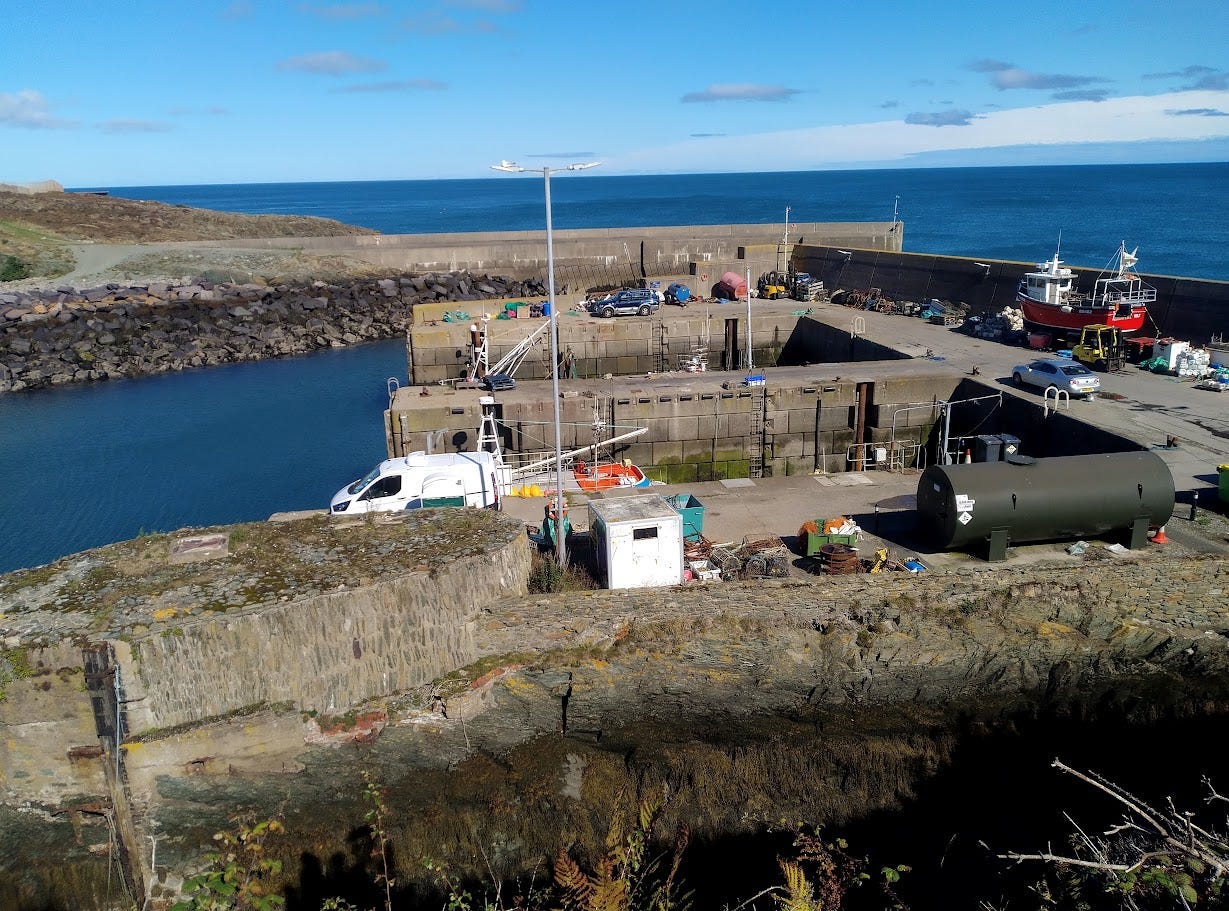
Amlwch Port
When I left school, I had taken the entrance exam for Oxford and a couple of months afterwards I learned that I had won a place at Pembroke College to study Modern History and would go “up” to Oxford later in the year. 1975 was therefore a part ‘gap year’, although the phrase ‘gap year’ was only just then becoming a popular phrase in the UK. I had determined to divide my gap of nine months by doing different jobs.
I was ravenous for new experiences and independence, but I had previous form here, having spent part of the previous year risking my A level results in an exchange term from Westminster School to Milton Academy, Massachusetts, USA. Milton Academy, like Westminster, was a privileged private school for the self-elected elite. Located in the suburbs of Boston, Massachusetts, USA, it boasted an echoing rollcall of establishment family names, including the scions of families Kennedy, Shriver, Cabot, Adams, and Logan. Just to complete the roll call, the singer James Taylor had been expelled from there a few years previously.
I had somehow in the previous few months become retrievably but passionately ‘workerist’ (although, emerging from public school, I had only just stopped using the term ‘painterly’), and remember deciding that for a politically honourable, satisfying and settled life as an adult all I had to do after I left school was to go up north (I fancied Yorkshire) and find a simple job and live in modest but contented obscurity for the rest of my life while working earnestly and dedicatedly for the socialist revolution.
I didn’t tell my Conservative MP father all that, and didn’t go through with it – my Oxford place beckoned, and I thought it was wiser not to turn that down. So this was not a life change option or an inverted career ploy. It wasn’t Eric Blair doing a down-and-out either, although I was jealous of his courage. But with a holiday job I might make it feel like that for a while – earning money and working like a proper working-class lad. And the first job of my truncated gap year was a real job in every way. A friend of my father had agreed to offer me a suitably hard-working manual job at the construction company where he was a director. I was to be a chain boy on a big building site in Hull, on the Humber.
I now realise the inevitability that there would be something of a botched handover about the apparently careful arrangements between my father and his building company director friend. I had spent Hogmanay in Scotland with my parents and Scottish cousins and my job was to start very early in January 1975 so I was to be dropped off in Hull on the way back south. I was very excited about it and thought myself mentally prepared for the challenge.
We all drove from Forfar to Hull just after the New Year. Arriving at the docks in the late afternoon, my parents almost left me at the building site office gate in what seemed a gigantic, hollowed, and dark portal to a darkened landscape of heavy industry, complete with the appropriate rhythmic foreground soundtrack. However, the site office cabin had no idea who I was and why I was there, so my father put it down to experience and a communications failure. We continued our journey back down to London, with me in a state of extended bathos. A few phone calls later back at home, a wayward message about the first job offer was discovered. This time I was reappointed to an equivalent building site on the other side of the country in Anglesey where the same construction company was building new breakwaters for the tugs coming around the British isles from the North Sea oil fields. My mother was a lot happier with this as she had been born in Wales and was fond of saying “look you” (which I don’t think I have heard anyone Welsh say away from the stage).
On the bus journey to Amlwch Port from Holyhead where the train from London had left me, a young Mum sat next to me. After a few introductory exchanges, tears appeared in her eyes, and when I asked her what was the matter, she suddenly poured out her broken heart to me about her marriage to an abusive man who didn’t love her anymore. She said he was violent and often hit her. She was having a tough life and as I listened, was aware that I was only having a tough conversation. We were separated by a gulf. She did most of the talking but while she never asked for help, I felt helpless to assist her. As she spoke, instead of looking at her all the time, I would pretend to admire the sights of North Wales from the rain-stained window. I asked about seeking help from social services, but she refused to tell anyone in authority about her nightmare as she was frightened of losing her two children. She even caught my arm, saying “don’t tell anyone what I have told you.” Women’s refuges and shelters from violent partners were only just starting to happen at the time and would not have arrived in Anglesey. She had nowhere to go. Her wistful comment “At least I’ve got my boys” remains seared in my memory. We parted and I have never since forgotten her or hoped that she had managed to become safer and happier in the rest of her life.
This time I was expected at the works gate. Someone had even found me a place to stay near the building site on the port. I was to be paid £15 per week in salary and the costs of my digs (also £15 a weel). I moved into a small but comfortable terraced house in Amlwch Port and started for once to feel genuinely independent and adventurous. Or, as much as I could be, consistent with having enough money to live on.
I and my posh accent were severely exposed in Anglesey. I tried as hard as I could to blend in, delivering a kind of Welsh-inflected Mockney when I spoke to anyone I didn’t already know. But even my language was exposed, as Anglesey was primarily Welsh-speaking, and I frequently had the problem, repeatedly covered in Hollywood films, of entering a pub and the whole place falling silent while I ordered a pint of bitter in my thin BBC newsreader voice. Many Anglesey residents were not only Welsh speakers, but, according to many of them, incapable of speaking English. Once. On the top of the cliff edge in Porth Eillian, a man asked me the time. I told him in English but he didn’t appear to understand the answer; I had to show him my watch. He looked at my wrist, grunted and moved on.
Living in Amlwch Port was a genuine adventure – just what I had been looking for, with all the thrilling fears of the unknown. Even better, I was well outside my normal and privileged experience. For a start, I lived in digs, just like 1950s professional footballers. I had a cooked breakfast and dinner on the table every evening provided by a kind old lady whose husband had died the weekend before I arrived. I adjusted my imagination to a highly repetitive schedule that lacked much in the way of insight or interest during the weekdays while I stayed in the digs. Fortunately, the workforce on the building site was varied enough that English was the lingua franca.
I didn’t have the money to buy much more than sandwiches in the works canteen and the occasional pint in the pub but somehow, I managed to survive on my pay. When I had to move out of the digs, prompted by the old lady’s decision to stop hosting local workers, I started to live in a sort of workers’ dormitory in the annex of a local hotel. We slept in a dormitory. There I mixed much more with my fellow workers who congregated at the hotel every evening as well as every Sunday in the bar (Sundays were dry in Anglesey at that time except for hotel residents, for whom they were extraordinarily wet).
The foreman of the site, Jack Kelly, was a very hard-bitten white-haired Irishman with a deep red face who took me under his wing. We talked together a great deal, and he bought me whiskeys when I ran out of money trying to keep up with the men’s Sunday drinking sessions. He once told me sagely never to start the night drinking whiskey if I wanted to avoid becoming an alcoholic, but he never followed his own advice and frequently fell off his stool despite his words of wisdom.
I had no friends outside the workers on the site, who were local and mostly married TV enthusiasts. How did I spend my evenings and weekends? I only remember reading in the evenings, and writing verse, and walking a lot. On a few occasions I hired a bicycle and cycled all over the island. The short time I spent there also featured my brief appearance in the English Football Association’s register of professional football players, as I was signed up by the manager of Bodffordd United, a team from a local village (population less than 400). The manager also worked for the construction company and had listened to me exaggerate my exploits as I described playing football for Westminster School’s first team. He brought signing papers with him the next day. I signed the papers and started training with the lads.
The league matches were more challenging, but I managed to play just three games and scored one goal before I took an injury. My teammates all called me Stan, since on the pitch they couldn’t get their mouth around the name ‘Lionel’, and one of them started calling me ‘Stabber’ Stan after my first and only goal for the mighty Bodffordd, stabbed in at close range at the far post in true striker fashion. I was paid by appearances and ended up owing them 50 pence on the whole deal after deductions for the laundry, referee, linesmen and pitch rental. My nickname of Stabber remains, used exclusively by my brothers-in-law who still find the moniker side-splittingly funny.
How I had obtained the holiday job was highly suspicious to the sceptical young buck surveyors with whom I worked as a chain boy. My job was to move the giant rule back and forth as they gazed knowingly through their theodolites. They supposed themselves to be the cleverest people on the site because they had degrees. Hefyn, who was the only Welshman in the surveyor’s office, was the most suspicious of me. One day, he asked “are you sure you’re not Albert Darnley’s son?” He was close to the mark, as I was Albert Darnley’s friend’s son but I had promised not to reveal how I had come by the job and couldn’t give this away as the unions, according to Albert, would immediately down tools and walk out, and quite possibly lynch me into the bargain.
My co-workers were not at all hostile, just interested and a little curious and bemused. They were very also accommodating and helpful in their bemusement. They (Hefyn the Welshman, a foul-mouthed Englishman called Harry and a mild-mannered Englishman called David) were friendly and welcoming. The Welsh generally were very good at hospitality once they knew you. Once or twice I was invited into other people’s homes, especially after coming back from the pub. This is where I would witness the spontaneous singing competitions that Welsh people indulge in as a matter of course at the week’s end. Everyone had to put in 10 or 15 pence (still called two or three shillings, as everyone was still referring to the new currency by the old name). We all tried to sing, and I, not a natural singer, always contributed the only music hall songs that I knew, which were ‘My old man’s a dustman’, ‘Champagne Charlie’, ‘My old man said the follow the van’, and ‘Bubbles’ The Welsh sang hymns. The same people always won the contest, which was decided by a show of hands afterwards, and they took all the money in the pot as the prize.
The duties of a chain boy did not consist exclusively of swaying a giant rule in front of a theodolite. On some days there were underwater explosions to dislodge large stones or ledges from Amlwch bay. I became a siren warning assistant to the divers, with at least a partial responsibility for those who might still be diving when the explosion was unleashed. Like the fish, they would be floating on the top of the water if they did not heed the warnings. On these days the hotels of Amlwch Port always had fresh fish on their menus. I got to know the divers on the site in evening pub talk. They were the best paid workers by far, making what seemed at the time like huge amounts of money for their exploits. I don’t think I had then ever realised that diving was not just a recreation but more often a difficult, exciting and well-paid job. The divers were the cocks of the walk, and all seemed to have large houses (and glamorous wives) elsewhere.
After a few weeks I was promoted to the post of concrete slump factor technician, which I performed regularly after a morning’s quick instruction. It was my job to check the viscosity of the mixed concrete when the lorries came and dumped the ready-mixed down on a large hard-standing. I had to step forward and check the slump factor with a metal cone that I scooped into the concrete then let it all slip out into a small box and measured the degree to which the level of concrete had slumped in 30 , 60 and 90 seconds.
Basically, I practically built those breakwaters.
For a while I hung around with a local lad my age who was also employed on the site for a while and who showed me another side of life – one that I was anxious to learn about. He invited me once to his house for Sunday lunch where I met his parents and his grandmother. I also went with him to meet his girlfriend who was still at school. We waited outside the school fence until the school finished while he told me about life in Anglesey. His girlfriend quickly introduced me to her girlfriend, and we all went out together one evening for a drink.
Fairly soon some gossip started and a story came to his hearing that I had been ‘messing around’ with his girlfriend. I denied it as I had in fact been messing around with his girlfriend’s girlfriend. There was no truth in the rumour and couldn’t have been, as his girlfriend also denied it. I was nevertheless subjected to some old-fashioned suspicion (oi, ay, you’ve been messing around with my girlfriend) for a while. I wondered if somehow this was a rite of passage. Was it significant to go through this stage with a new mate in Wales? He concluded after a day or two that ‘somebody had been shit-stirring’. This was the first time I had heard this expression, and told him primly that I was more used to the term ‘muck-raking’. “It’s all the same”, he said, rightly.
The job introduced me to what I knew to be a good sample of the real working life that I had not then experienced at close range. It was a temporary adventure but in most other respects it was also real and demanding. I worked eight hours a day five days a week and got to know people at work and outside. It cured me forever of my shyness. It gave me confidence. I had full and sociable weekends whether walking, cycling, drinking or playing football as ‘Stabber Stan’. While I knew I would not be staying, it gave me some priceless memories of the island, its countryside, its weather, and its people.