
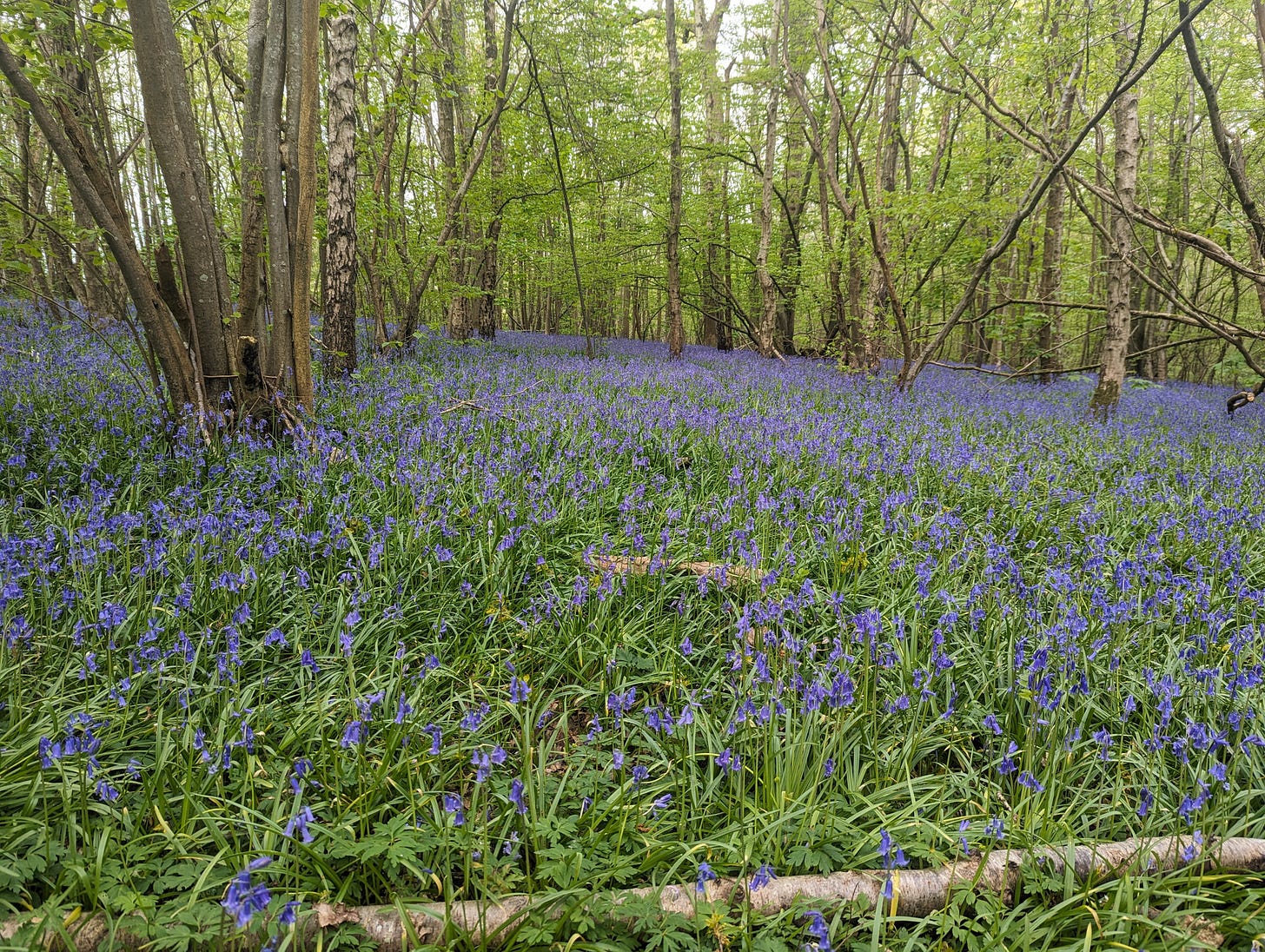
Amazingly, the UK’s woodlands contain nearly half of the world’s population of bluebells. It’s (obviously) a perennial. They have evolved to exploit the window between late winter and late Spring in the UK, with all its countless variations. All the photosynthesis occurs in less than eight weeks before the sky is closed by the woodland canopy.
The bluebell is slow to colonise. It does not rush into new territory. Its presence in a woodland indicates long-established woodland cover but the bluebell waves of colour are denser and more widespread than they were in eighty years ago.
The appearance of bluebells in unwooded settings — hedgerows, rough grassland, even coastal meadows — annually surprises many people who associate them exclusively with the dappled floor of ancient woodland. But this is not new. In fact, the presence of bluebells in hedgerows and under bracken on pastures indicate that the land was once covered in woodland — the bulbs persisted in the soil even as the trees were cleared centuries ago. However, there are many more examples today of non-woodland growth, reflecting the many changes in cultivation, coppicing, and agriculture since 1945.
Every year many people claim that the “Spanish” bluebell, the Hyacinthoides Hispanica, is taking over, chasing out the indigenous bluebell like grey squirrels confronting the indigenous red. Taller, more upright, with broader strap-like leaves, and paler blue flowers arranged symmetrically around a stiff, erect stem rather than drooping to one side, and with no scent — it originated in Spain, Portugal and North Africa, and was introduced to the UK as a garden plant in the 17th century, though gradually it escaped and was first recorded growing in the wild in 1909.
The English and the Spanish bluebell strains mixed and formed a hybrid, Massartiana, which was first recorded in 1963. Most of the Hyacinthoides x Massartiana found in UK gardens, woods, fields and lawns are forms of this hybrid, which is robust and highly fertile. They may be pure non-scripta, pure hispanica, or anywhere on a spectrum between the two — displaying varied combinations of stem posture, flower arrangement, scent, and colour. In short, most bluebells in newer urban areas are hybrids of varying compositions.
The picture is nothing like the red-versus-grey squirrel proposition. One is not driving the other into extinction. Both are surviving and both are prospering. Hybridisation is generally absent or minimal in native bluebell populations in ancient woodlands and hedgerows in rural areas. The hybrids are growing in the newer areas they tend to colonise disturbed habitats — roadsides, churchyards, garden margins, woodland entrances — rather than penetrating the dense, established carpets of non-scripta in ancient interior woodland (very few of which remain in southeast England).
In rural ancient woodland interiors, the native species remains dominant and largely intact, except where confronted by bulldozers and earth diggers creating concrete and tarmac surfaces.
In urban woodlands, suburban parks, garden boundaries ,and young woodland on the fringes of towns, most bluebells are hybrids.
Nevertheless, the extraordinary spectacle now spreading across British woodlands every April and May is real, often breath-taking, and genuinely more widespread than it was eighty years ago.
Deep in ancient woods, far from any garden or agriculture, the native bluebells persist and flourish: the narrow, drooping, violet-scented Hyacinthoides non-scripta, unchanged since the last Ice Age, filling a spring morning with a fragrance that has no equivalent in any other garden variety.
In other words, if you want to find the original bluebell in its original form, do not look in the newer and suburban woodlands where bluebells have been appearing more profusely each year but in the ancient woodlands where you may have seen them for the first time many years ago. These bluebells are still there in their own glorious profusion. But hybrid bluebells are almost as wonderful (even if unscented).
